
When you’re building parts for aircrafts, engines, or satellites, “good enough” doesn’t cut it. Whether it’s a fuel control component in a jet engine or a hydraulic actuator on a wing, aerospace parts must survive extreme cold, intense heat, and continuous exposure to aggressive chemicals.
Keeping those parts working long-term comes down to choosing the right surface finish. While classic electroplating has been the go-to for decades, more aerospace engineers are turning to Electroless Nickel (EN) Plating.
But why is EN plating critical for aerospace applications, how does phosphorus content dictate performance, what specifications say and guide us to do, and how to we choose an AS9100D partner to take away the risk of the supply chain. These are all things we look to highlight below.
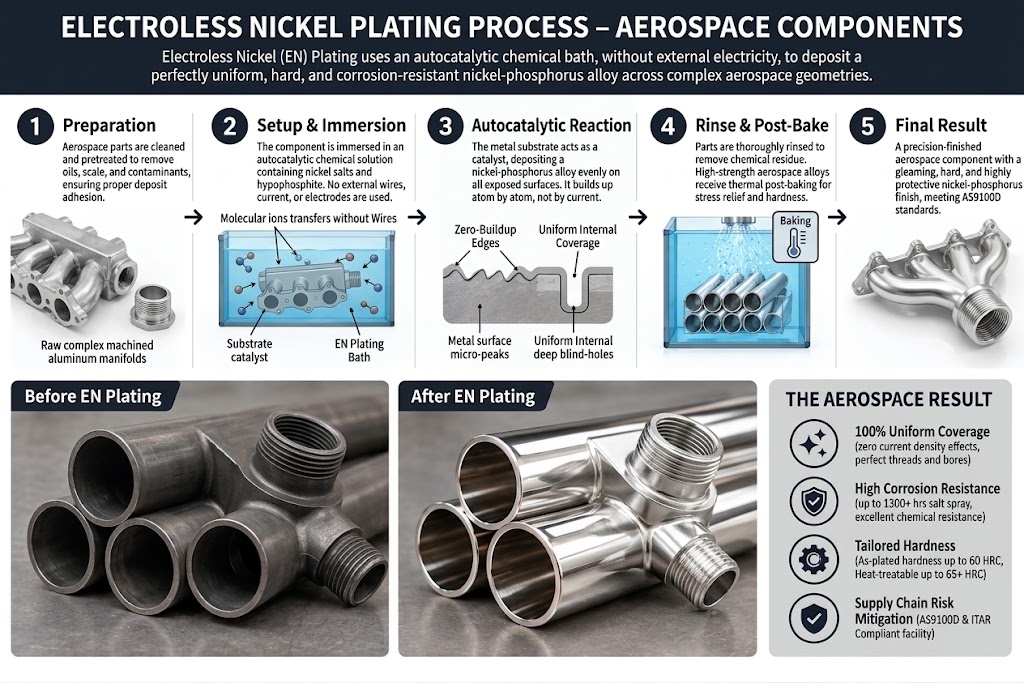
Key Differences and Benefits to Electroless Nickel
- Traditional electroplating relies on current to drive the metal ion deposition on the customer part. This inherently creates the opportunity for non-uniform thickness. Coatings notoriously build up differently based on the geometry, where exterior edges have more thickness than blind holes or internal threads.
- Electroless nickel plating operates through an autocatalytic chemical reaction without any applied current. The substrate acts as the catalyst, allowing the nickel-phosphorus alloy to deposit evenly over every surface subjected to chemical solution.
Why is this important in aerospace applications:
- Because its an autocatalytic, and current density and geometry doesn’t have as much of an impact, edge build up is significantly reduced thus reducing the need for post grinding operations on precision, machined tolerances.
- The versatility of the chemistry. EN has excellent reactivity and adhesion to a wide variety of substrates, most notably, aluminum, copper, stainless steel, and various ferrous-based substrates. In some chemistry blends, even titanium is suitable to be EN plated. All these alloys are common in the aerospace industry.
Phosphorus Content and the ideal environment for end operations.
The performance of an electroless nickel coating comes down to the phosphorus content. What the ultimate need for a customer’s parts will dictate which EN to use, whether that’s extreme hardness or corrosion resistance. There are three particular chemical varieties of these electroless nickel chemistries:
- Low-Phos (1 – 4%)
- When the phosphorus is lowest, the hardness is at its highest, it offers little corrosion protection, but notable for is its performance in high wear areas like drives and gears.
- Nearly 60+ HRC, < 100hrs @ 1.5mil (40µm).
- When the phosphorus is lowest, the hardness is at its highest, it offers little corrosion protection, but notable for is its performance in high wear areas like drives and gears.
- Mid-Phos (5 – 9%)
- The “all around” electroless nickel. It balances moderate hardness with decent corrosion protection. Ideal for brackets, housings, hydraulic components and the like.
- 45 – 50 HRC, < 175hrs @ 2.0mil (50µm)
- The “all around” electroless nickel. It balances moderate hardness with decent corrosion protection. Ideal for brackets, housings, hydraulic components and the like.
- High-Phos (10 – 13%)
- The best corrosion barrier. It’s slightly softer and more flexible but can handle substantial hours when tested in ASTM B117 NSS. Fuel system components, aircraft parts and extreme environment exposures are ideal applications for this EN.
- 40 – 45 HRC, < 1,300hrs @ 2.0mil (50µm)
- The best corrosion barrier. It’s slightly softer and more flexible but can handle substantial hours when tested in ASTM B117 NSS. Fuel system components, aircraft parts and extreme environment exposures are ideal applications for this EN.
PRO TIP: If you need extra hardness without going to something less environmentally friendly, like a hard chrome, Low and Mid-Phos EN coatings can be heat-treated after plating to exceed 65 – 70 HRC, only sacrificing a modest amount of corrosion protection.
The Specifications You Need to Know: ASTM B733, MIL-C-26074 (AMS-C-26074), and AMS 2404
If you are putting EN on an engineering drawing or PO, you’ll most often call out these two specifications:
- ASTM B733
- This is the go-to standard for EN Coatings. It sets clear rules on phosphorus levels and coating thickness resulting in no ambiguity and ‘everyone’ being on the same page.
- AMS-C-26074 (Formerly MIL-C-26074)
- This is your most frequently noted military standard. It covers strict process controls, adhesion testing, corrosion limits and post bake requirements to prevent any embrittlement concerns in high strength metals.
Choosing an AS9100D Partner
At the end of the day, a high-tech finish is only as good as the team applying it. In aerospace, working with an AS9100D-certified and ITAR-registered shop means your parts are handled under strict, traceable quality standards from start to finish.
Our RIE Coatings facility in Albuquerque is fully AS9100D certified and ITAR registered, helping aerospace and defense OEMs get repeatable, worry-free finishes every time.
Got a Tough Finishing Challenge?
Whether you’re trying to stop wear on a mechanical gear or protect complex flight control manifolds from harsh weather, we’re here to help.
RIE Coatings
Your Partner in Metal Finishing Solutions.
Built For Trust. Engineered for Performance.